BUYING
Dubai Property Supply vs Demand in 2026
Has the Dubai real estate market reached a turning point, or is there still room for growth? Supply forecasts are everywhere. Social media posts talk about more than 120,000 homes entering the market over the next few years, analysts are debating future price movements, and opinions seem to change every week.
But behind the headlines lies a different reality. New supply is entering the market, but buyer demand is growing as well. So let's cut through the headlines with actual data and look at the reality of buying in Dubai this year.
Key Takeaways
- Around 77,500 homes are scheduled for delivery in 2026.
- Dubai South, JVC, Business Bay, Arjan, Dubai Hills Estate, MBR City, and Dubailand are seeing the most new supply.
- Rental growth slowed in Q1 2026 as more completed homes entered the market.
- UAE residents now make up a growing share of property investors.
Where Does the Dubai Property Market Stand Right Now?
Let's start with the transaction numbers, because they tell you everything about real demand.
According to data from the Public Debt Management Office (DMO), Dubai closed 2025 with over 270,000 real estate transactions worth AED 917 billion, representing a 20% year-on-year increase in both volume and value. Total real estate transactions across sales, leases, and services hit 3.11 million in 2025, up 7% on the year before. The market also attracted 193,100 investors in 2025, a 24% jump year-on-year, with 56.6% of them identified as UAE residents.
The momentum carried straight into 2026. The Dubai Land Department (DLD) reported that total real estate transactions in Q1 2026 reached AED 252 billion, a 31% year-on-year increase in value and a 6% rise in volume, with 60,303 transactions recorded in the quarter.
Numbers at this scale suggest that buyer demand is firmly established. A market facing weak demand would show slowing transaction activity, declining investor participation, or lower deal values. Dubai's data points in the opposite direction. Buyers are still entering the market, investors are still deploying capital, and transaction volumes are near record levels.
What Does Dubai's Housing Pipeline Look Like in 2026?
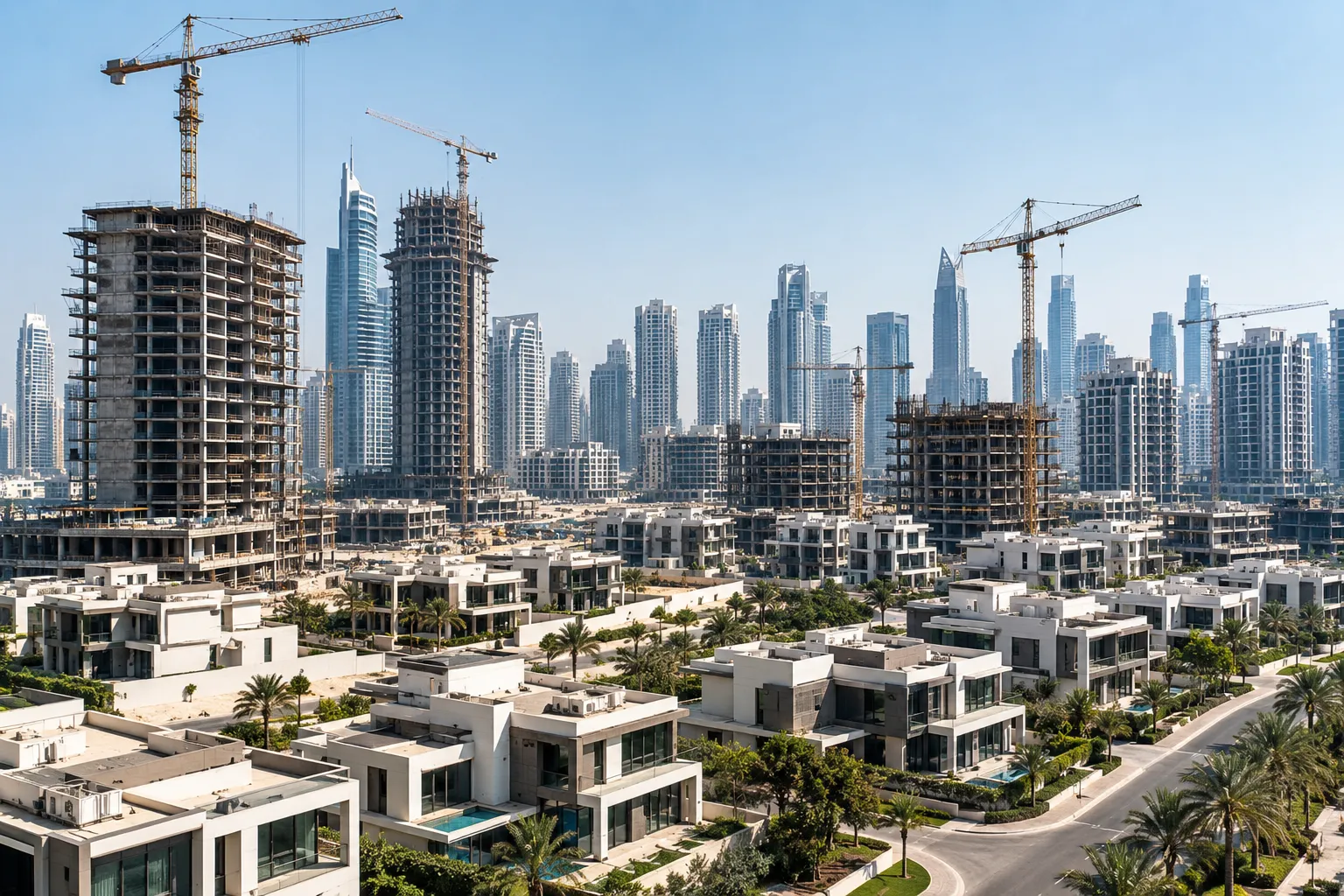
Estimates for Dubai's 2026 housing pipeline vary considerably depending on the research firm and methodology used. Gulf News cites around 77,500 units, with 29,600 scheduled for Q2 alone, while other analysts put the full-year scheduled figure as high as 111,000 to 160,000 units. This spread reflects genuine differences in how forecasts are compiled rather than a single agreed number, so the figures below should be read as one informed estimate among several.
This pattern is consistent across multiple independent analyses. One widely cited 2026 forecast estimates that only around 48% of scheduled units will actually reach handover, while another suggests the realistic full-year figure may land closer to 60,000 to 70,000 units regardless of which higher headline estimate is used. The gap between scheduled and actual delivery is not a one-off observation, it is a well-documented, recurring feature of Dubai's development pipeline.
Delayed projects are more likely to push supply into later periods than remove it from the market entirely, so the pipeline is real, but delivery timelines rarely match the original forecasts. That gap between scheduled and actual completions is the single most important thing buyers need to understand right now.
This gap is largely structural rather than a sign of market distress. Construction permitting, infrastructure dependencies, and project sequencing all routinely push completions later than initially announced, and developers also have an incentive to phase handovers deliberately so the market can absorb new supply without sudden price shocks. Buyers should treat this pattern as a normal feature of how the Dubai market operates, not as a red flag.
Another 146,000 homes are scheduled for 2027, followed by 120,100 in 2028. Supply is increasing, just not at the pace the quarter-to-quarter headline numbers suggest.
A large portion of that upcoming supply is concentrated in communities that have seen substantial development activity over the past few years:
- Dubai South
- Jumeirah Village Circle
- Business Bay
- Arjan
- Dubai Hills Estate
- Mohammed Bin Rashid City
- Dubailand master communities
Many of these locations have become major off-plan investment destinations. Buyers considering property in these communities should pay close attention to future handover volumes, as new supply can influence pricing, rental performance, and competition among sellers and landlords.
It is also worth noting that a large share of the 2026 pipeline already has buyers attached. Recent data shows that 78.55% of homes scheduled for completion in 2026 are already sold, with several major developers reporting near-complete sellouts of their 2026 deliveries, Emaar at 99.1%, Meraas at 99.77%, and Damac at 99.17%. This matters because it means most of this incoming supply does not represent speculative, unsold inventory entering the market in search of a buyer. It has already found one, which materially changes how this supply should be interpreted.
Villas vs Apartments
Not all property types are moving in the same direction, and buyers need to know exactly where the gaps are.
Villas have been the standout performer across this entire cycle. Villa prices jumped 26.4% year-on-year in 2025, with the biggest gains coming from Jumeirah Islands (+39%), Palm Jumeirah (+38.6%), and The Meadows/Jumeirah Village Triangle (+24.7%). Mid-market areas such as Al Furjan, Arabian Ranches 2, and Murooj Al Furjan climbed by 17–28%.
Established master communities are not expanding indefinitely. Buyers who want a ready villa with outdoor space in a quality neighbourhood are competing for a limited pool of stock. Villa and townhouse rental yields averaged 5% in Q1 2026, with some of the highest returns recorded in Al Barari, Dubai Industrial City, and DAMAC Hills 2.
Apartments tell a different story depending on location and price point. Affordable apartment areas delivered the sharpest price gains in 2025. Dubai Silicon Oasis posted a 29% price-per-square-foot increase on the back of the Blue Line Metro announcement. Arjan, DAMAC Hills 2, and Dubai South followed with gains of 9–25%.
On the yield side, apartment rental yields averaged 7.2% in Q1 2026, with International City Phase 2, International City Phase 1, and Downtown Jebel Ali delivering among the highest returns in the city. Apartments in budget and mid-market communities continue to attract investors who want steady rental income, not just capital appreciation.
Where do Buyers Need to be Careful?
Mid-market apartments in areas with a heavy incoming supply pipeline.
More units landing in the same neighbourhood at the same time creates more choice for buyers and renters, which naturally limits price growth and can bring rents down slightly.
Off-Plan vs Ready Properties
Off-plan properties in Dubai dominated Q1 2026.
Q1 2026 Off-Plan Market Snapshot | Figure |
Share of residential transactions | 73% |
Off-plan units sold | 32,300+ |
Transaction value | AED 105.5 billion |
Growth compared with Q1 2025 | 35% |
Purchases made directly from developers | 92% |
Purchases made directly from developers in March 2026 | 94% |
Source: Gulf News
Note: off-plan share figures vary across sources depending on whether they measure all transactions, residential transactions only, or value versus volume. The 73% figure above refers specifically to residential transactions in Q1 2026 as reported by Gulf News.
Buyer interest is being driven by payment plans that reduce upfront costs, launch prices lower than those of completed properties, and the opportunity to enter emerging communities before they mature. Dubai South, Jumeirah Village Circle, and several developing districts on the city's outskirts are attracting a large share of that demand.
Ready properties are holding firm in the secondary market. Apartments accounted for over 80% of transactions across completed properties during the first quarter of 2026. Demand is strongest in segments that offer a relatively accessible entry price and the potential for steady rental income.
Taken together, the data suggest that buyers are still entering the market across both segments. Off-plan projects are attracting those willing to wait until completion, while ready properties appeal to buyers seeking immediate occupancy or rental income.
What is the Rental Market Telling Buyers?
The rental market is still growing, but the pace has slowed. According to Gulf News, average rents increased by 10.2% year-on-year in Q1 2026, the lowest annual growth rate recorded since 2022. Around 149,000 rental contracts were registered during the quarter, with renewals accounting for 66% of the total.
A larger supply of completed homes entering the market during late 2025 and early 2026 has given tenants broader options. As a result, landlords face competition in some communities, particularly those receiving a high volume of new handovers.
Buyers should pay close attention to that shift. A property in a community with limited upcoming inventory may perform very differently from one in an area where thousands of units are scheduled for delivery over the next few years.
Rental growth is no longer moving at the same pace across the city. Community fundamentals now play a much larger role in determining rental demand and income potential.
What Buyers Should Watch in 2026?

Four things are worth tracking in the current real estate market.
Actual Handover Numbers
Scheduled delivery figures attract headlines, but actual handovers tell a more accurate story. Chances are that completed units may fall well below the number originally scheduled for delivery. Buyers should keep an eye on quarterly handover data and completed inventory entering the market.
Where New Supply Is Being Delivered
Supply is not arriving evenly across Dubai. A large share of upcoming inventory is expected in communities such as Dubai South, Jumeirah Village Circle, and parts of Dubailand. Established locations such as Palm Jumeirah, Dubai Hills Estate, and Emirates Hills operate under different supply conditions. Demand in these communities is being absorbed by a much smaller pool of available homes.
Who Is Buying
Investor demographics are changing. Dubai Land Department data shows that 56.6% of the 193,100 investors who entered the market in 2025 were UAE residents. Long-term residents converting from renting to buying create demand that does not disappear when global sentiment shifts.
Rental Yields
Markets where apartment yields average 7.2% and villa yields average 5% attract capital. Buyers earning a solid yield are not going to sell at the first sign of additional supply.
It is also worth noting that several independent analysts specifically identify 2027, rather than 2026, as the year where Dubai's supply pipeline will most meaningfully test demand absorption. Both 2025 and 2026 deliveries have run well below their original schedules, while 2027 represents a significant step up in actual completions across multiple forecasts. Buyers planning a longer hold should factor this timeline into their thinking rather than treating 2026 in isolation.
Final Thoughts
A market transitioning from 20%-plus annual growth to more measured appreciation is not a market in trouble. Dubai's property market is entering a more mature phase, in which new supply aligns with end-user demand. Buyers who have been waiting for a crash will likely keep waiting. Population growth keeps pushing demand. Rental yields keep attracting investors. DLD transaction data keeps hitting new records. The real question in 2026 is not whether to buy, but what to buy and where.
At Linda’s, we work with buyers who are purchasing their first home, upgrading from an apartment to a villa, or building a rental portfolio. We give a realistic look at what is available right now, what the numbers say about a specific property, and whether it fits what you are trying to achieve.
Browse available properties on Linda’s or speak with an advisor today. A 15-minute conversation can save you months of scrolling.