BUYING
Foreigner’s Guide to Buying Property in Dubai
Thousands of people from over 200 nationalities buy property in Dubai every single year. Yes, Dubai opens its doors to global property buyers, but the local system can take some time to grasp. Laws, payment plans, off-plan builds, service fees, and residency visas all come with specific rules.
You do not need to figure it all out alone. A closer look at the facts gives you total control over your purchase from day one. Let's look at how the market actually operates.
Key Takeaways
- Foreign buyers can own property outright in designated freehold areas across Dubai.
- Mortgage requirements become stricter as property values increase.
- Service charges can affect net investment returns over time.
- Dubai's fixed currency peg to the US dollar reduces exchange-rate uncertainty for many investors.
- Annual property taxes and capital gains taxes do not apply to residential property ownership in Dubai.
Where Can Foreigners Buy Property in Dubai?
The UAE government opened up property ownership to non-nationals in 2002. Before that, foreigners had no path to owning real estate in Dubai. That one policy change turned the city into one of the most open property markets in the world for international buyers.
Today, two ownership types exist in Dubai:
- Freehold Ownership
- Leasehold Ownership
Freehold Property Ownership in Dubai
Freehold property ownership is governed by Dubai Law No. 7 of 2006 Concerning Real Property Registration. This law allows non-GCC nationals to acquire permanent ownership rights over real estate within designated zones.
The Dubai Land Department issues a title deed, which provides the legal right to sell, lease, or pass the asset down as an inheritance to heirs without restrictions. Most of Dubai's popular areas operate as freehold zones. Foreign buyers purchase without restrictions in communities like:
- Dubai Marina
- Downtown Dubai
- Palm Jumeirah
- Jumeirah Village Circle (JVC)
- Business Bay
- Jumeirah Lake Towers (JLT)
Leasehold Property Ownership in Dubai
Leasehold ownership operates under a different legal structure, in which a buyer purchases the right to use and occupy a property for a fixed period. These contracts run from 30 to 99 years.
A buyer owns the physical structure or unit for the duration of the contract, but does not hold the title to the underlying land. The land rights remain with the original freeholder, usually a master developer or a local landowner. Once the lease period ends, control of the property reverts to the freeholder unless an extension or renewal is agreed upon.
Leasehold properties exist primarily in specific areas outside the main tourist hubs, such as parts of Dubai Silicon Oasis or Deira.
Types of Properties Available in Dubai
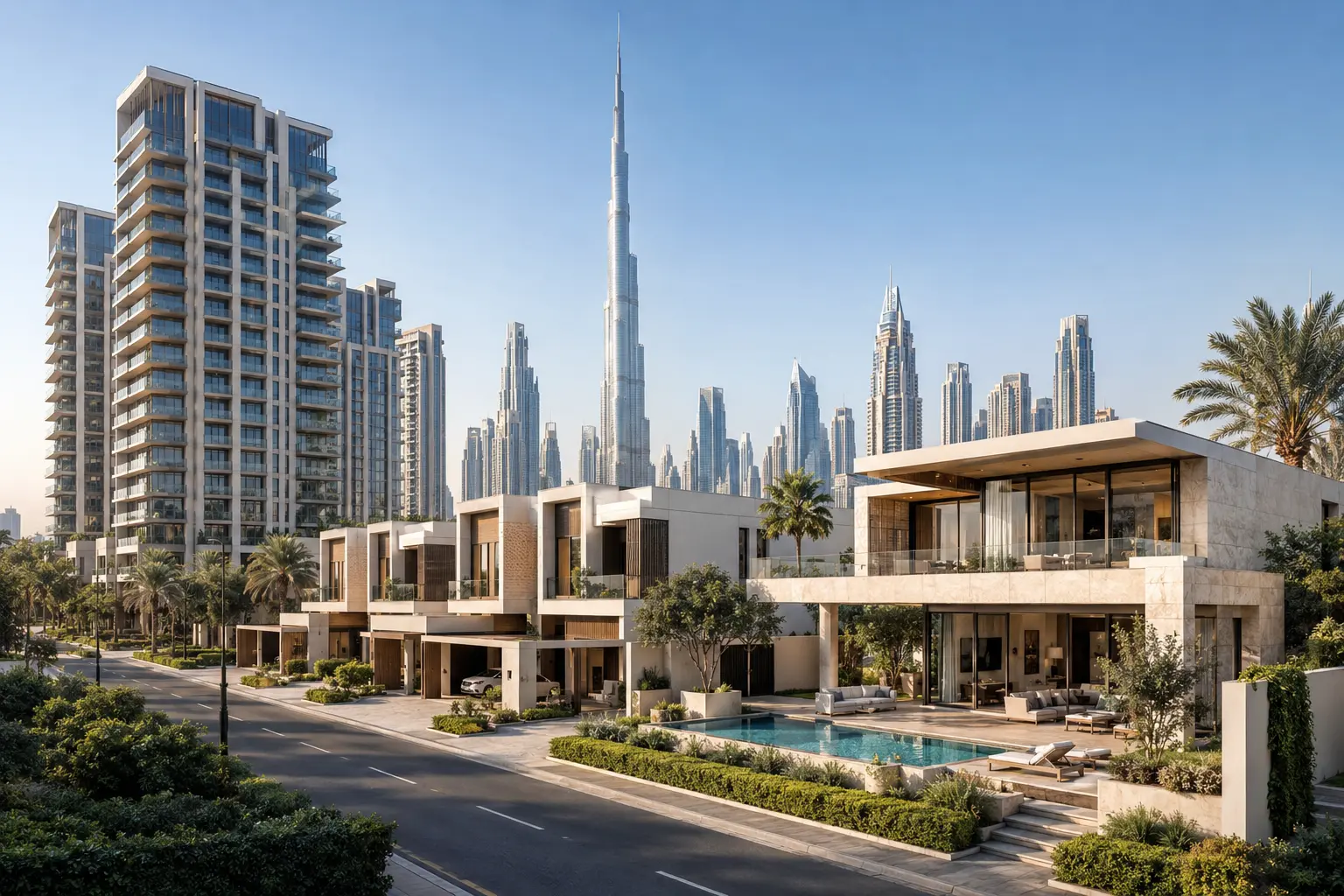
Dubai offers a wide range of property options for different budgets and lifestyles.
Apartments
Apartments represent the largest share of real estate transactions in the city. Overseas buyers select these units for predictable rental demand and centralised building management.
The average purchase price for an apartment in Dubai is around AED 2,000,000. The average cost per square foot across the apartment sector is approximately AED 1,959. High-density districts like Dubai Marina and Business Bay see consistent transactional activity.
Here is a closer look at the average apartment prices across different unit types:
Apartment Type | Average Sales Price |
Studio Apartment | AED 785,000 |
1-Bed Apartment | AED 1,410,000 |
2-Bed Apartment | AED 2,720,000 |
3-Bed Apartment | AED 4,840,000 |
4-Bed Apartment | AED 6,320,000 |
Source: Property Monitor
Townhouses and Villas
Villas and townhouses carry a higher entry price point but provide distinct stability. The median price per square foot for a villa is approximately AED 2,148. Gated family developments offer larger floor plans across established suburban communities.
Below are the average villa prices in Dubai across different unit types:
Villa Type | Average Sales Price |
3-Bed Villa | AED 6,323,000 |
4-Bed Villa | AED 9,461,340 |
5-Bed Villa | AED 15,301,885 |
Source: Property Monitor
Townhouses serve as an entry point for land-tied real estate. Average entry purchase prices across family areas range from 2,500,000 AED to 4,000,000 AED.
Townhouse Type | Average Sales Price |
2-Bed Townhouse | AED 2,135,970 |
3-Bed Townhouse | AED 3,316,680 |
4-Bed Townhouse | AED 4,180,000 |
Off-Plan vs. Ready Properties
Buyers can also choose between fully constructed properties and units still under development.
Off-Plan Properties in Dubai
Dubai off-plan properties are Units purchased before or during the construction phase. Developers incentivise buyers with phased instalment plans tied to building progress milestones rather than requiring full upfront capital.
Non-resident buyers should note that bank financing for off-plan units might be unavailable to them as some lenders restrict off-plan mortgages to UAE residents. Non-residents purchasing off-plan typically rely on the developer's own payment plan rather than bank financing.
Ready Properties in Dubai
Ready properties are fully completed properties available for immediate handover. These properties suit buyers who require direct occupancy or immediate monthly cash flow from rentals to service capital costs.
Additional Costs of Buying a Property in Dubai
Buyers must prepare for additional transactional expenses beyond the base purchase price. Under Central Bank directives, all transaction fees must be paid upfront in cash, as commercial banks are prohibited from adding these costs to the core mortgage loan.
Dubai Land Department Fees: 4% of the total property sale value
Real Estate Agency Commission: 2% of the purchase price (+ 5% VAT)
DLD Registration Trustee Fee: AED 4,000 (+ 5% VAT) for units over AED 500,000
DLD Registration Trustee Fee: AED 2,000 (+ 5% VAT) for units under AED 500,000
Title Deed Issuance Fee: AED 250 to 580, depending on unit type
Mortgage Financing Parameters
Foreign buyers utilising local banking facilities face strict Loan-to-Value (LTV) limits set by the central regulatory system. Down payment tiers require specific liquid funds based on property valuation:
Properties below AED 5,000,000: Non-national resident buyers must provide a minimum 20% down payment.
Properties above AED 5,000,000: The required down payment allocation rises to 30% of the total purchase price.
Non-resident overseas buyers: Financing limits are more conservative, generally requiring a 30% to 50% upfront down payment on ready properties, depending on the lending bank. Some of the UAE banks do not extend off-plan mortgage financing to non-residents at all, meaning non-resident buyers purchasing off-plan typically need to fund the purchase entirely through cash or the developer's own payment plan.
Buyers using mortgage finance should also budget for several loan-related fees payable during the purchase process:
Bank Processing Fees: 1% of the total loan volume.
Property Valuation Fees: Fixed charges between 2,500 AED and 3,500 AED (+ 5% VAT) paid to bank-appointed surveyors.
Mortgage Registration Fees: 0.25% of the total loan amount paid to the land registry office.
Ongoing Community Service Charges
Owners face annual maintenance expenses managed under the regulatory framework. These service charges are billed per square foot annually based on historical maintenance data tracked by the DLD Service Charge Index:
- Affordable Communities: Average AED 7 to 12 per square foot (e.g., International City).
- Mid-Market and Prime Hubs: Average AED 14 to 28 per square foot (e.g., Dubai Marina, Business Bay).
- Ultra-Premium Towers: Can exceed AED 40 to 70 per square foot (e.g., Downtown Dubai, Burj Khalifa).
Cash buyers avoid bank processing and valuation steps, but still pay the standard registration, agency, and land department administrative fees.
What Rental Yields Look Like in Dubai?

Dubai delivers some of the strongest gross rental yields among major global cities. In high-demand, affordable areas such as Jumeirah Village Circle (JVC), Dubai Silicon Oasis, and International City, gross yields range from 7% to 9% annually. In premium spots like Downtown Dubai and Dubai Marina, yields run between 5% to 7%.
London averages around 3% to 4% gross yield. Sydney runs closer to 2.5%-3.5%. The gap is meaningful, especially for investors building a passive income portfolio.
ROI for Short-Term Rentals
Short-term rentals have also grown significantly. A one-bedroom apartment in Dubai Marina can generate AED 80,000 to AED 120,000 per year on short-term rental platforms, depending on occupancy and season.
Managing properties through short-term models entails cost profiles that differ from those of standard year-long leases. Operators face asset management fees ranging from 15% to 20% of gross revenues, continuous utility bills, and routine interior maintenance expenses.
Mandatory DET Compliance and Fee Structures
Before registering with DET, confirm that the specific building permits short-term rentals, this decision rests with the developer or the building's owners' association, not with DET. Most towers in Dubai Marina, JBR, Downtown Dubai, Business Bay, and Palm Jumeirah allow holiday homes, while many villa communities such as Arabian Ranches and The Springs explicitly prohibit them. Confirming this before purchase prevents buying a unit intended for short-term rental only to discover the building's rules don't allow it.
Before listing on any short-term platform, owners must register with Dubai's Department of Economy and Tourism (DET). The government body monitors holiday home operations through an online portal. The process is simple, and the registration fees are reasonable.
Initial Registration and Inspection: Individual property accounts require a formal registration fee of AED 1,520. Mandatory property inspection fees cost AED 320 to ensure compliance with municipal safety and quality standards.
Unit Permit Fees: Annual permit fees vary based on the property's size. Studio or one-bedroom units cost AED 370 per year. Two-bedroom properties require AED 670, and the cost scales up to AED 1,270 for properties with four or more bedrooms.
Tourism Dirham Tax: Landlords collect a nightly fee from guests and remit it to the DET monthly. Standard properties incur a tax of AED 10 per bedroom, per night, while deluxe-rated structures require AED 15 per bedroom, per night. This means a two-bedroom holiday home pays double the per-unit rate compared to a one-bedroom property, a detail worth factoring into yield calculations for larger units.
Operators should also be aware of VAT obligations. Once short-term rental turnover exceeds AED 375,000 in any 12-month period, VAT registration with the Federal Tax Authority becomes mandatory, with voluntary registration available from AED 187,500. This typically only becomes relevant for investors operating multiple units rather than a single holiday home.
How the Buying Process Works in Dubai?
The purchase of real estate moves through a structured legal workflow. Complete compliance with these stages protects buyer capital and secures ownership records in accordance with municipal guidelines.
Here is the step-by-step breakdown of how a standard transaction unfolds
1. Hiring a Licensed Broker
Source a unit through a broker certified by the Real Estate Regulatory Agency (RERA). Every active agent must carry a valid RERA registration card. Inspect this card or verify its status in the official Dubai REST mobile application before signing any documentation or issuing any funds.
2. Signing Form F
Once terms are agreed upon, both parties sign a Memorandum of Understanding, officially known as Form F. This legally binding document outlines the final purchase price, payment schedules, and custom penalty clauses for breaches of contract.
3. Paying the Deposit
Securing the contract requires the buyer to issue a standard 10% security deposit. This payment is written as a manager's check made out to the seller or a brokerage escrow account. The broker retains this check and does not cash it unless a party defaults.
4. Finalising Mortgage Approval (If Applicable)
Buyers using mortgage finance must complete the bank's approval process before the transaction can move forward. The lender conducts a valuation of the property to confirm its market value and ensure it meets lending requirements. Signing Form F without pre-approval places your 10% deposit at immense risk if the bank later rejects your application.
Once approved, the bank issues a final offer letter and prepares the funds for transfer. Buyers are also required to settle mortgage-related charges, such as valuation fees, arrangement fees, and registration costs, before completion.
5. Securing the Developer NOC
The seller must apply for a No Objection Certificate (NOC) directly from the master developer. This document confirms that the current owner has paid all building maintenance fees and community service charges in full. Processing takes 5 to 7 working days, with administrative fees ranging from AED 1,000 to AED 5,000.
6. Transferring Ownership
After the NOC is issued, both parties meet at a licensed Dubai Land Department (DLD) registration trustee office. The buyer presents manager's checks covering the remaining purchase balance, the 4% DLD transfer fee, and trustee service charges. Clerks update the central registry and issue a new digital title deed to the buyer. This total journey spans roughly 30 to 60 days for ready homes.
Why Dubai Attracts Foreign Property Buyers
Dubai's growth from a regional trade hub into a global real estate destination rests on distinct financial and structural advantages.
Tax Advantages
The local tax framework is a primary driver for international property acquisitions. Dubai does not impose annual property taxes on residential real estate, which lowers long-term holding costs compared to major global cities.
Personal income tax stands at 0% for individual residents. Landlords retain the entirety of their rental income without local tax deductions. While corporate tax rules apply to certain commercial operations, individual residential investments face no direct capital gains tax upon resale.
Global Connectivity
Geographic positioning enables the city to serve as a central logistics and business hub. Dubai International Airport offers direct flights to the main cities across Europe, Asia, Africa, and North America. This infrastructure supports professionals who manage international business interests. Remote workers, corporate executives, and business owners utilise the city as a base because major commercial markets are within reasonable flight times.
Currency Stability and Valuation
The United Arab Emirates Dirham (AED) is pegged to the United States Dollar (USD) at a fixed rate of 3.6725. It removes currency-fluctuation risks for investors whose primary funds are tied to the USD or to currencies that are stable against it.
Property valuations offer a different entry point than in other global hubs. Premium real estate space costs less per square meter than comparable space in London, Hong Kong, or New York. The table below outlines price entries across primary neighbourhoods.
Neighborhood | Property Type | Entry Price (AED) |
Jumeirah Village Circle | 1-Bed Apartment | 750,000 - 1,150,000 |
Dubai Marina | 1-Bed Apartment | 1,300,000 - 1,800,000 |
Downtown Dubai | 1-Bed Apartment | 1,700,000 - 2,400,000 |
Source: Property Monitor
Infrastructure and Safety
Long-term residential demand depends heavily on civic infrastructure. The road networks, public transit systems, and utility infrastructure support a growing population.
The city maintains low crime rates, which influence families considering a permanent relocation. The presence of international curriculum schools, private healthcare facilities, and developed retail districts provides the necessary support structure for community growth.
Property Buying Risks Foreign Investors Should Check

Investing capital in a foreign real estate market requires strict risk management. Several common issues can affect your returns or tie up your money if left unchecked before you sign a contract.
Keep these specific safety checks in mind during your property search:
- Verify the developer holds an active RERA registration and has a dedicated escrow account for the project.
- Send all instalment payments to that specific escrow account rather than to the general developer business funds.
- Request the official RERA-approved community service charge rate from the seller to check maintenance costs.
- Review historical building data to ensure the community management team avoids unexpected fee increases.
- Hire an independent property lawyer to inspect the sale contract terms for unfavourable exit clauses.
Conclusion
A successful real estate purchase depends entirely on accurate data, careful verification, and patience. The city offers substantial financial advantages, but the local legal framework requires full attention at every stage. Take your time to research communities, inspect developer records, and calculate all upfront costs before you make a commitment. With the right facts in hand, you can confidently navigate the market and secure an asset that aligns with your long-term goals.
Every successful property purchase starts with the right information. Connect with Linda’s property consultants to explore Dubai’s property market with confidence and clarity.