INVESTMENT
Dubai Property Investment Guide for First-Time Investors
Dubai recorded 214,912 property sales worth approximately AED 682.5 billion in 2025, making it another record year for the market. For someone considering their first property investment, that level of activity can feel both encouraging and difficult to navigate. The headline benefits are widely discussed, but the details that shape the actual return are just as important.
Tax treatment, potential rental returns and long-term residency options often form part of the appeal.
Key Takeaways
- Individuals generally do not pay UAE personal income tax on rental income or capital gains from property held as a personal investment, although tax obligations may still arise in their country of residence or under a business structure.
- Foreign nationals can own property outright in designated freehold areas across Dubai.
- Off-plan property can offer phased payment plans and access to newer developments, but its price should always be compared with similar ready properties in the same area.
- Buyers should usually allow approximately 6% to 8% or more above the agreed price for transaction costs, depending on the brokerage agreement and whether a mortgage is involved.
- Ownership of one or more properties with a qualifying value of at least AED 2 million may support an application for Golden Residency, subject to the current GDRFA requirements and the financing structure.
- Net rental yield settles lower than the advertised gross number once service charges and vacancy are factored in.
Why Invest in Dubai Real Estate as a First-Time Investor?
Dubai has earned a place on the shortlist for first-time property investors across the world. Tax advantages, healthy rental returns, and full ownership rights all play a part, but each benefit deserves a closer look before you commit your money.
No Personal Tax on Rental Income
Individuals generally do not pay UAE personal income tax on rental income or gains from property held as a personal investment. Qualifying real estate investment income earned by a natural person is also excluded from the scope of UAE Corporate Tax. However, the position may differ when a property is owned through a company, operated as a licensed business or subject to tax in the investor’s country of residence. Independent tax advice is sensible where cross-border obligations may apply.
You may also like: How Service Charges Affect Property Returns in Dubai
Rental Returns Stand Out
Average gross rental yields across Dubai generally range between 5% and 9%. A studio in Jumeirah Village Circle can produce around 7.5% to 9%, and a one-bedroom apartment in Dubai Marina records around 5.5% to 7%. Those figures compare well with several established international property markets.
Full Ownership in Freehold Areas
More than 70 freehold communities allow non-UAE nationals to own apartments, villas, and townhouses with full legal ownership. Buyers can resell the Dubai property, lease it, or pass ownership to family members without a local partner.
No market promises a profit every time. Every investment carries risk, and Dubai property prices can go down as well as up. But the fundamentals explain why so many first-time buyers pick Dubai over their own home markets.
Ownership Rules for Foreign Buyers

Not every part of Dubai allows foreign buyers to own property outright. Areas outside the designated freehold zones are available under leasehold arrangements, commonly for up to 99 years, without full ownership rights.
Dubai Marina, Downtown Dubai, Business Bay, Jumeirah Village Circle, Dubai Hills Estate, Arjan, and Dubai South rank among the most popular freehold communities for first-time buyers. Each area comes with its own price range, rental demand, and investment potential. Some suit buyers looking for steady rental income, and others appeal to those aiming for long-term capital growth.
One final check before signing any agreement can save a costly mistake. Confirm that the project is located within a freehold area through the Dubai Land Department and verify that the developer is registered with the Real Estate Regulatory Agency (RERA). Spending a few minutes on that step can prevent legal and financial problems later.
Off-Plan vs Ready Property in Dubai
The first choice many buyers make is deciding between an off-plan property and a ready home.
An off-plan property in Dubai is purchased before construction is complete. Some projects launch before work even begins on site. Buyers secure today's price and pay over several construction stages until handover.
Ready property is exactly what the name suggests. The building is complete, the apartment or villa can be inspected, and ownership transfers once the transaction is complete. If the property is vacant, ready for occupation and successfully let, rental income can begin without waiting for construction to be completed.
Payment flexibility is one reason first-time investors consider off-plan property. Many developments offer staged payment plans, reducing the amount due at the beginning of the purchase. Price, however, should still be compared with similar ready and resale properties, as a new launch is not automatically cheaper on a price-per-square-foot basis.
Every investment comes with trade-offs. Construction schedules do not always go as planned. Reviewing the developer's completed projects and delivery history before paying a booking amount can prevent expensive surprises.
Dubai law requires payments received from off-plan purchasers to be deposited into the project’s approved escrow account. Funds are managed and released for permitted project costs in accordance with the escrow agreement and verified construction progress.
Ready homes remove much of that uncertainty. You know the exact unit, the building condition, the surrounding community, and the rental demand before signing the transfer documents.
Comparison | Off Plan | Ready |
Share of Dubai transactions (2025) | About 64% | About 36% |
Price difference | Around 10% to 18% below comparable ready homes | Market value |
Payment structure | Instalments linked to construction milestones | Full payment or mortgage at transfer |
Rental income | After handover | Immediately after purchase if leased |
Suitable for | Long-term capital growth | Immediate rental income |
Dubai Property Prices Per Square Foot by Area
According to data from Property Monitor, Dubai's average price per square foot was around AED 1,900 to AED 1,976 in early 2026, roughly 12% higher than the same period a year earlier. Comparing the average price per square foot gives a realistic picture of what your budget can buy before you look at individual properties.
Downtown Dubai: around AED 3,170 per sq ft on average. A small studio starts near AED 1.5 million, with prices rising sharply in the more established towers.
Dubai Marina: around AED 2,000 to AED 2,060 per sq ft. A studio can be found from about AED 900,000; a two-bedroom unit trades well above AED 2 million.
Business Bay: around AED 2,000 to AED 2,200 per sq ft, with strong liquidity and around 940 transactions logged in a single month in early 2026. It consistently ranks among the most active areas by transaction count.
Jumeirah Village Circle (JVC): around AED 1,470 to AED 1,800 per sq ft, one of the most active mid-range areas by transaction count.
Palm Jumeirah: around AED 3,800 per sq ft on average, the top of the ready residential market.
Emerging areas along Dubai's southern corridor, Nadd Hessa, Jabal Ali, and Dubai South among them, sell below AED 1,400 per sq ft. These areas posted the fastest year-on-year price growth in early 2026, some over 35%.
Dubai Rental Yields by Area
Rental returns vary just as much as purchase prices, so two apartments with the same budget can produce very different income.
Area | Average Gross Rental Yield |
Jumeirah Village Circle | 7.5% to 9.5% |
Business Bay | 6% to 8% |
Dubai Marina | 5.5% to 7.2% |
Downtown Dubai | 4% to 6% |
Dubai South | 7% to 8.5% |
Arjan | 7% to 8.5% |
Gross yield is calculated before expenses, so it never matches the money that reaches your bank account. Service charges for apartments commonly range from AED 8 to AED 32 per square foot per year. Vacancy between tenants and property management costs also reduce the final return.
A property advertised with a 9% gross yield may produce around 5.5% to 6.5% net, depending on annual costs and occupancy. Looking at both figures gives a much more realistic picture of expected income.
How Much Does It Cost to Buy Property in Dubai?
The advertised price covers only the property itself. Government fees, brokerage charges, and transfer costs are paid before the property is registered in your name.
Cost | Amount |
Dubai Land Department transfer fee | 4% of the purchase price |
Real estate agency commission | 2% of the purchase price |
Mortgage registration fee | 0.25% of the loan amount |
Trustee office fee | Up to AED 4,000 |
Annual service charges | Vary by building, unit size, and community |
Most buyers should budget around 7% to 8% above the property's purchase price to cover one-time buying costs. Annual service charges come after the purchase and depend on the building, amenities, and the size of the property, so they should also form part of your long-term budget.
Dubai Golden Visa Through Property Investment
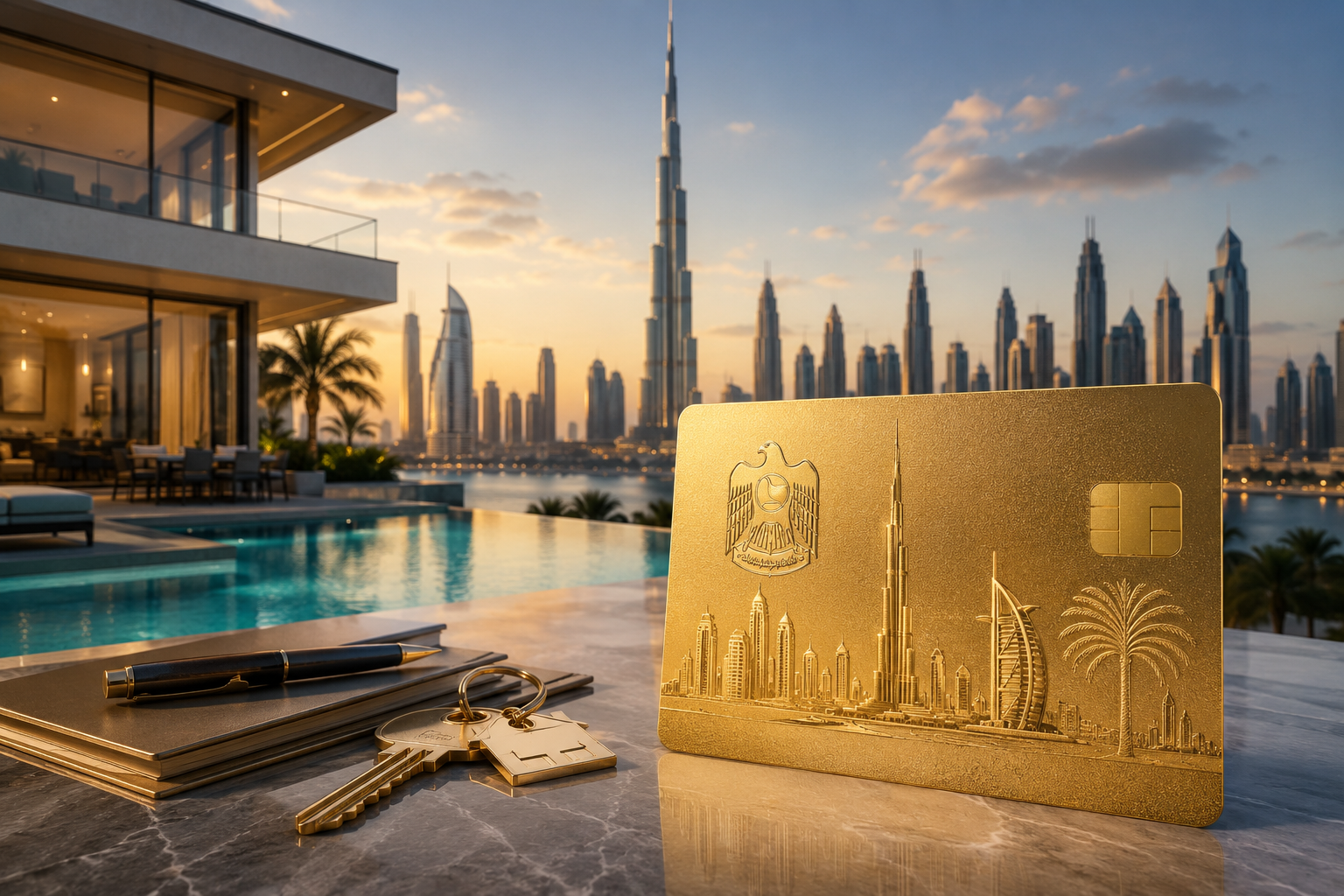
A property worth AED 2 million or more, in a freehold zone, opens the door to a 10-year UAE Golden Visa. As of 2026, the government dropped the old rule that required 50% of the value paid upfront. Mortgaged property now qualifies too, as long as the total purchase price is at least AED 2 million and the bank issues a standard no-objection letter to proceed with the residency application.
You can also combine multiple properties to reach the AED 2 million total. It works well if you want to spread your budget across smaller units in different areas, and skip putting everything into one villa. The visa comes with no minimum physical presence requirement, and it lets you sponsor a spouse, children, and domestic staff.
Buyers who want residency alongside a return on their money get a meaningful bonus here. Buyers who only want rental income should not treat the visa as a reason to overpay for a property that does not otherwise make sense.
How to Buy Your First Property in Dubai
- Set a realistic budget that covers the 7% to 8% in extra costs above, not just the sale price.
- Pick a goal, monthly rental income, long-term price growth, or both together, and let it guide the area you shortlist.
- Shortlist two or three areas based on that goal and compare price per square foot and rental yield in each.
- Check the developer and building through DLD and RERA records before signing anything, for off-plan and ready property alike.
- Get mortgage pre-approval early if financing is required.Fixed rates for non-residents in 2026 are generally in the range of 4.5% to 5.25%. Rates, loan-to-value limits and eligibility vary by lender, residency status, income and property, so use a current personalised quotation rather than a general market rate.
- Sign the unified contract (Form F / MOU for ready property, or an SPA for off-plan), pay the deposit, and register the transaction with DLD.
- Budget for service charges and a management company if you plan to rent the unit out and you do not live in the UAE.
Common Mistakes First-Time Property Investors Make in Dubai

A few mistakes appear among first-time buyers. Most are easy to avoid with a little research before signing the sales agreement.
- A low purchase price can lose its value if annual service charges are much higher than comparable buildings.
- Gross yield looks attractive on paper, but net yield is the figure that reflects your actual return after expenses.
- Rental projections should be based on recent comparable transactions, not only the highest asking rents currently advertised online.
- Freehold status should always be verified before signing a sales agreement because not every area allows full foreign ownership.
- A developer's delivery record deserves as much attention as the property itself, especially when buying off plan.
- Marketing material can create a strong first impression, but completed projects reveal far more about build quality and delivery standards.
- Buying purely on price can lead to weaker long-term returns if rental demand in the area is limited.
- Mortgage costs, registration fees, and annual ownership expenses should all be calculated before deciding what fits your budget.
- An investment should also be tested against periods of vacancy, unexpected maintenance and changes in mortgage costs, rather than calculated only under ideal conditions.
Conclusion
Dubai gives property investors a wide range of locations, property types and ownership options, but the right investment will look different for every buyer. A property that suits someone prioritising immediate rental income may not suit someone comfortable waiting for a longer-term development plan.
The most useful comparisons are often the most specific: the achieved rent in the same building, recent sales of similar units, the approved service charge, the developer’s delivery record and the total amount of cash required to complete the purchase. These details provide a clearer picture than a headline yield or launch price alone.
At Linda’s, our role is to help buyers understand both the property and the community around it, using real market evidence and practical local knowledge.
Explore the latest Dubai property listings at Linda’s or speak with a property expert to find an investment that matches your budget and objectives.