RENTING
Tips for Relocating to Dubai with Family
Moving to Dubai with your household brings a long checklist. Families look at schools, healthcare, housing costs, transport, and daily routines before finalising the big move. A city may look attractive during a short visit, but daily family life depends on practical details that shape comfort over time.
Dubai attracts families from around the world because of its safety, modern infrastructure, career opportunities, and residential communities designed for family living. Areas across the city offer parks, schools, supermarkets, clinics, and leisure facilities within short driving distance. Expats make up nearly 90% of the population. Such a large number makes Dubai one of the most international cities in the world.
Parents naturally want to make the right choices for children and household finances. Learning the actual numbers and rules of the local property market makes the transition much smoother.
Key Takeaways
- A household of four needs a minimum of AED 20,000 to 35,000 per month.
- Top schools fill up months in advance.
- Expect upfront costs of around 10% above the listed rent for the security deposit and agency fee, plus an ongoing 5% municipality housing fee charged monthly through your DEWA utility bill.
- The Dubai Land Department rental calculator legally protects tenants from unfair rent hikes.
- Traffic dictates daily comfort, so living near your office or school can save hours of commuting time.
Understand Dubai’s Residential Areas
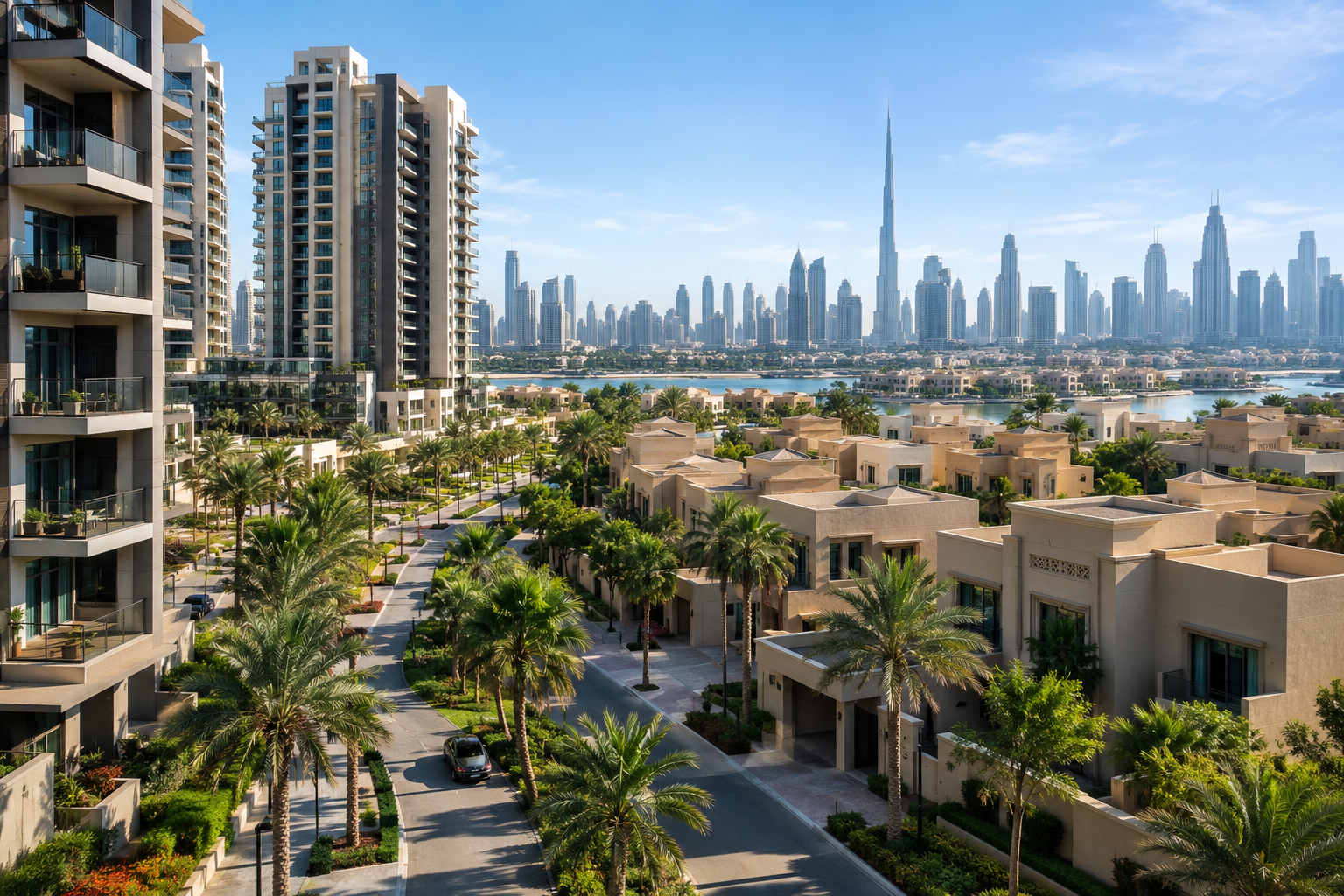
Every Dubai community offers a different lifestyle. Some neighbourhoods suit large families looking for villas and outdoor space. Others attract professionals seeking apartments near business districts and metro stations.
Families relocating with children usually consider factors such as:
- Distance to school
- Commute time to work
- Access to parks and clinics
- Community safety
- Rental prices
- Nearby supermarkets and malls
Popular Family Communities in Dubai
Here are some of the most popular options for families.
Dubai Hills Estate: A high-end community built around an 18-hole championship golf course. Families get access to massive open spaces spanning 1,450,000 square metres. Three-bedroom villas in clusters, such as Maple, rent for 240,000 AED to 280,000 AED annually. Premium areas like Sidra go higher. Prestigious campuses like GEMS Wellington Academy are directly in the area.
Arabian Ranches: A long-standing suburban community with a desert-themed design. Tree-lined streets and parks make walking safe for kids. Three-bedroom villas here range from 160,000 AED to 270,000 AED annually. Retail centres and clinics operate directly inside the community gates.
Jumeirah Village Circle (JVC): This area is a top mid-tier choice for family living due to its immense popularity. Small families find apartments ranging from 75,000 AED to 95,000 AED per year.
Mirdif: A traditional Arabic and contemporary Middle Eastern villa area close to Dubai International Airport. It attracts residents because of accessibility. Three-bedroom properties fall in the affordable bracket, ranging from 110,000 AED to 145,000 AED annually. Mirdif City Centre provides a massive retail hub for grocery shopping and children's entertainment.
The Springs: A gated community featuring scenic artificial lakes and green pathways. Families live here to experience a quiet, suburban pace. Two- and three-bedroom townhouses generally rent for 140,000-260,000 AED per year.
Villa communities in Dubai offer larger layouts, private outdoor areas, and quieter surroundings. Apartment districts may provide easier access to metro stations, offices, restaurants, and entertainment venues. Visiting communities before signing a tenancy contract gives families a better understanding of traffic conditions, parking, noise levels, and nearby facilities.
Prepare a Realistic Monthly Budget
Dubai offers housing options across a range of price points. Monthly expenses vary depending on family size, school selection, and lifestyle choices. While costs differ from one household to another, the figures below provide a useful benchmark for planning a family budget.
Category | Budget Lifestyle (AED) | Comfortable Lifestyle (AED) | Premium Lifestyle (AED) |
Rent (3-Bed) | 7,000 to 9,000 | 9,000 to 12,000 | 14,000 to 25,000+ |
School Fees (2 Kids) | 2,500 to 3,500 | 5,000 to 8,000 | 10,000 to 15,000+ |
Groceries | 2,000 to 2,500 | 3,000 to 3,800 | 4,000 to 5,500 |
Transport | 800 to 1,500 | 2,000 to 3,000 | 3,500 to 5,500 |
Health Insurance | 800 to 1,000 | 1,200 to 1,800 | 2,000 to 4,000 |
Utilities & Internet | 800 to 1,000 | 1,000 to 1,400 | 1,400 to 1,800 |
Dining & Outings | 1,000 to 1,500 | 2,000 to 3,500 | 4,000 to 6,000 |
Annual Flights (Amortised) | 700 to 900 | 900 to 1,500 | 1,500 to 2,500 |
Total Monthly Average | 15,600 to 20,400 | 24,100 to 34,000 | 39,400 to 60,000+ |
The monthly expenses outlined above do not include several one-time relocation costs. Families moving from abroad should also budget for temporary accommodation, furniture, car rentals, and school registration fees during their first few weeks in Dubai.
Start School Research Early
School admissions have become one of the biggest concerns for parents relocating to Dubai. Some popular schools receive applications months before the academic year starts.
For the most competitive schools, particularly those rated Outstanding by KHDA, applications for the following September intake often open as early as October or November the year before. Families planning a summer move should begin school research and submit applications at least six to nine months in advance, where possible. For mid-year enrolment, contact schools directly as some maintain waiting lists while others have more flexibility outside the main intake window.
Dubai has a huge variety of education systems:
- British curriculum schools
- American curriculum schools
- International Baccalaureate (IB) schools
- Indian curriculum schools
- Pakistani curriculum schools
- French and other international schools
Annual tuition fees vary widely based on the curriculum and facilities. High-end international schools, such as Dubai College or GEMS World Academy, charge over AED 80,000 per year. Mid-range schools charge between AED 20,000 and 45,000, depending on the grade level. Indian curriculum schools typically fall in a lower bracket, ranging from AED 10,000 to 30,000 annually.
Parents should review these key factors:
KHDA Ratings: The Knowledge and Human Development Authority inspects private schools annually. Ratings go from "Outstanding" and "Very Good" down to "Acceptable" and "Weak". The most recent full KHDA inspection cycle was 2023–24, when 23 schools were rated Outstanding out of 209 inspected. Full inspections have been paused for both the 2024–25 and 2025–26 academic years, with targeted monitoring visits taking place instead. Ratings from the last full cycle remain a useful reference, but check the official KHDA website for the latest available reports and confirm directly with schools whether their rating has been reviewed recently.
Transport Availability: School transport is provided by specialist operators, such as School Transport Services (STS). Families should budget approximately AED 5,000 to AED 10,000 per child per year for bus services.
Curriculum Structure: British schools run from September to June and follow FS1 up to Year 13. Indian schools follow the CBSE or ICSE boards and run from April to March.
Student Support Services: Check whether the school offers dedicated support for English as a Second Language (ESL) or for special educational needs if your child requires them.
Distance From Home: Long daily travel times can affect children and parents alike. Many families choose homes near schools to reduce commuting time during busy weekday mornings.
Understand Dubai’s Rental Process

Dubai’s rental process differs from that of expats' home countries. Learning the local regulations protects household finances and ensures a smooth move.
Most long-term rentals require specific documents:
- Emirates ID application
- Passport copies
- Residence visa
- Security deposit
- Signed tenancy agreement
The Dubai tenancy contract must be registered through Ejari, Dubai’s official rental registration system. Landlords or agents handle this online, or tenants can visit a physical centre. Ejari registration becomes necessary for utility activation, internet setup, and sponsoring family visas.
Reading all terms carefully before signing helps avoid disputes later. Families should check:
Maintenance Responsibilities: Contracts state that minor repairs under AED 500 are the tenant's responsibility, while major repairs are the landlord's responsibility. Verify these exact figures in the contract.
Chiller Charges: Air conditioning bills can double your monthly utility costs. Clarify whether central cooling is "chiller-free" (paid by the landlord) or if you must pay a separate district cooling company like Empower or Emicool.
Parking Allocation: Confirm how many covered parking bays come with the property. Families with more than one vehicle should also check the availability of additional resident and visitor parking.
Renewal Conditions: Landlords must give 90 days' written notice before the end of the contract to change the rent or lease terms.
Early Termination Clauses: Most standard contracts require tenants to pay a penalty equal to two months' rent if they break the lease early.
Working with established, RERA-licensed real estate agencies reduces the risk of fraudulent listings. Always verify an agent's broker ID on the official Dubai REST app before handing over any holding deposits or commission cheques.
Tenants who believe their landlord has served a rent increase notice without the required 90-day written notice, or that exceeds the amount permitted by the RERA Rental Index, can file a complaint through the Dubai Land Department's rental dispute centre.
Learn the Daily Commute Before Picking a Community
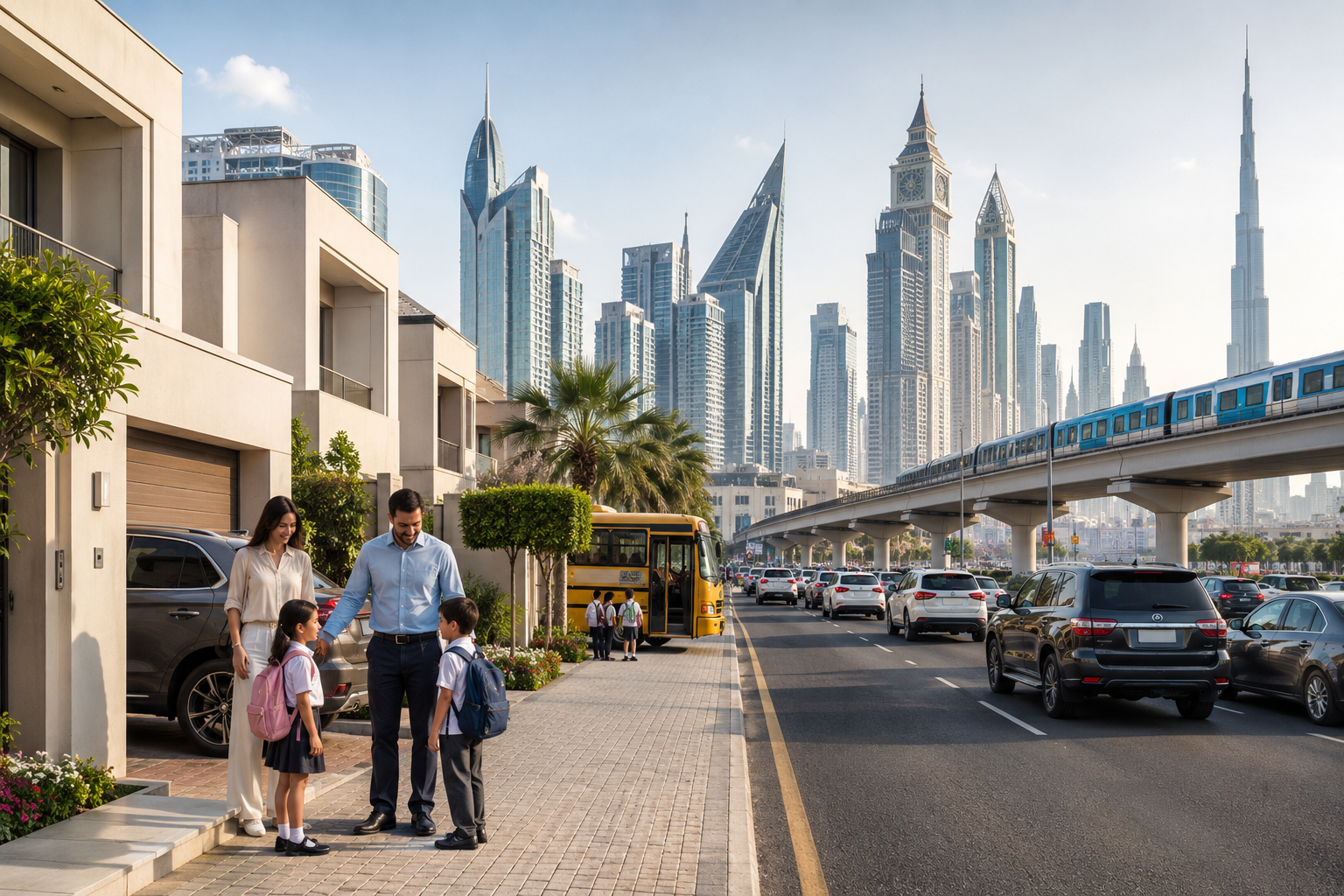
Dubai looks compact on maps. The reality is, heavy traffic during peak hours adds a lot of travel time to the daily routine. Understanding the roads is a must before signing a lease.
The times below reflect typical off-peak journeys.
Peak-hour traffic can have a great impact on daily travel times. Journeys that take 20 minutes may take twice as long between 7:30 AM and 9:00 AM or from 5:00 PM to 7:00 PM. Always test your intended commute at peak times before committing to a community
Parents working in major business hubs must check morning and evening travel times before selecting a home.
Business Bay and DIFC: Central business districts draw massive crowds. Commuting here from suburban villa communities like Arabian Ranches or Dubai Hills Estate takes 15 to 25 minutes during the 8:00 AM rush. Sheikh Zayed Road and Al Khail Road get very busy at these times.
Dubai Internet City: Positioned toward the southern end of the city. Communities like Jumeirah Village Circle (JVC) or The Springs offer a much shorter 15 to 20-minute commute to the area.
Jebel Ali: A major industrial and commercial zone on the far western edge. Living in Al Furjan or Discovery Gardens keeps the commute down to under 20 minutes.
Metro access matters for families relying on public transport. The Dubai Metro is fully air-conditioned and is a great asset during the hot summer months. Red Line stations run along the main highway. These tracks connect major hubs such as Dubai Marina, DMCC, and DIFC. Choosing a home within walking distance of a station reduces transport costs and commuting stress.
Families with children also need to consider school bus times and after-school activities when planning daily schedules. School buses pick up children very early. Drivers often arrive between 6:30 AM and 7:00 AM to beat the heavy traffic. If children participate in after-school sports or music lessons, parents must account for the additional driving trips required in the late afternoon.
Set Up Healthcare and Insurance
Health insurance is mandatory in Dubai. Employers commonly provide medical insurance for employees; however, family coverage policies vary between companies.
Parents must confirm these specific insurance details:
Family Medical Coverage: Some companies cover a spouse and up to three children. Other companies only provide a basic cash allowance. Ask HR for the exact policy details before assuming the whole household has medical protection.
Pediatric Care Access: Check the network list to see which clinics and doctors children can visit. Premium networks let families access top facilities such as Al Jalila Children's Hospital and Mediclinic. Basic networks restrict visits to specific local clinics.
Dental Coverage: Many entry-level health insurance plans provide limited or no coverage for routine dental services. Purchasing additional dental coverage can make ongoing care and orthodontic treatment more affordable.
Maternity Services: The law requires a minimum level of maternity coverage for married women. Waiting periods or coverage limits apply depending on the specific policy grade.
Emergency Hospital Access: Know which hospitals are in-network for the specific insurance plan for urgent care. Finding out during a crisis causes unnecessary panic.
Dubai has a strong healthcare sector with government and private hospitals across the city. Family communities generally have nearby clinics and pharmacies within short driving distance. Established providers such as Aster DM Healthcare, Mediclinic, and King's College Hospital London maintain facilities in many of Dubai's key residential districts.
Prepare for Dubai’s Climate
Adjusting to the local weather takes some time for families arriving from cooler countries. Summer temperatures regularly cross 40°C between June and September. Humidity peaks during these months, so daytime outdoor activity is severely limited.
During these months, families prefer:
- Indoor play activities
- Evening outings
- Mall visits
- Early morning exercise routines
Homes with shaded parking, swimming pools, and indoor community facilities are highly attractive to many families because of the weather. Always check if the community has a chilled pool, otherwise the water can get too warm to swim in during peak summer weeks.
Understand Cultural and Social Life

Dubai is home to residents from more than 200 nationalities. Expats make up a huge chunk of the city, so people find it easy to fit in without feeling like outsiders.
Kids get a massive bonus out of this. They go to class with children from dozens of different countries. They also naturally learn to appreciate different cultures, just by playing on the swings or doing group projects at school.
A few cultural norms are worth keeping in mind. Modest dress is expected in government buildings and older parts of the city. Eating and drinking in public during daylight hours in Ramadan is best avoided out of respect for those fasting. Beyond these basics, Dubai's large and well-connected expat community makes it easy to build a social life quickly. School parent WhatsApp groups become active early in the academic year. Most residential communities also organise seasonal gatherings, sports days, and holiday events that give families a natural way to meet neighbours from the very first weeks after arrival
Families should also be aware that working hours are legally reduced by two hours per day during Ramadan across most sectors, and school days are similarly shortened. If your move coincides with Ramadan, which shifts approximately eleven days earlier each year, this will affect daily routines, school pickup times, and restaurant availability during daylight hours.
Build a Support Network Early
Relocation affects children and parents emotionally. New schools, fresh routines, and unfamiliar social environments take a massive amount of adjustment. Community groups, school parent networks, sports clubs, and local events help families settle into the community. Many residential communities organise seasonal activities and family gatherings. Friends who have been through the same transition help reduce the initial isolation. A stable support system makes relocation much easier to handle during that crucial first year.
Final Thoughts
A move to Dubai with your household involves school planning, budget setup, transport routes, healthcare networks, and neighbourhood checks. They all shape the daily routine after arrival. Families who prepare ahead naturally settle faster and make better long-term housing choices. Time dedicated to researching areas and learning the practical details of daily life prevents expensive mistakes later on. Dubai provides a huge variety of residential communities suited to different household sizes, budgets, and lifestyles. Careful planning before arrival helps parents build a comfortable routine and ensures a much smoother transition into city life.
Let us take the stress out of your move. Our licensed property consultants are familiar with every school district and family community mentioned in this guide. We listen to your specific needs to find the ideal property for your household budget.
Speak with a Dubai real estate consultant to get a curated list of family-friendly properties that fit your criteria!